provBookR




Generates interactive, web-native digital booklet codices of R computational provenance.
Nature of Provenance
How scientific results come to be is the product of various domain-specific, economic, historical, social, and technical factors. Information about how these factors shaped and produced these results is essential to both artistic trade and scientific reproducibility. Whether these results are material or digital, provenance provides the historical accounts of objects: paintings, bones, essays, scientific tables, and plots.
Advancing Scientific Reproducibility
For ecologists and the wider scientific community, the reproducibility of computational experiments is a critical challenge. Modern research relies heavily on complex data pipelines, and understanding exactly how a result was derived is essential for verifying, replicating, and building upon scientific claims.
provBookR addresses this by bridging formal provenance research with practical software engineering workflows. It utilizes End-to-end-provenance tools (such as rdtLite) to automatically collect the execution history of R scripts and packages that provenance into an interactive, static web booklet built with SvelteKit.
This allows researchers to visually explore the lineage of their data pipelines and specific R objects (e.g., plots, models, variables) through a browser-based reading experience. By making provenance transparent and easily shareable without requiring specialized backend infrastructure, provBookR empowers the scientific community to elevate the standard of computational reproducibility.
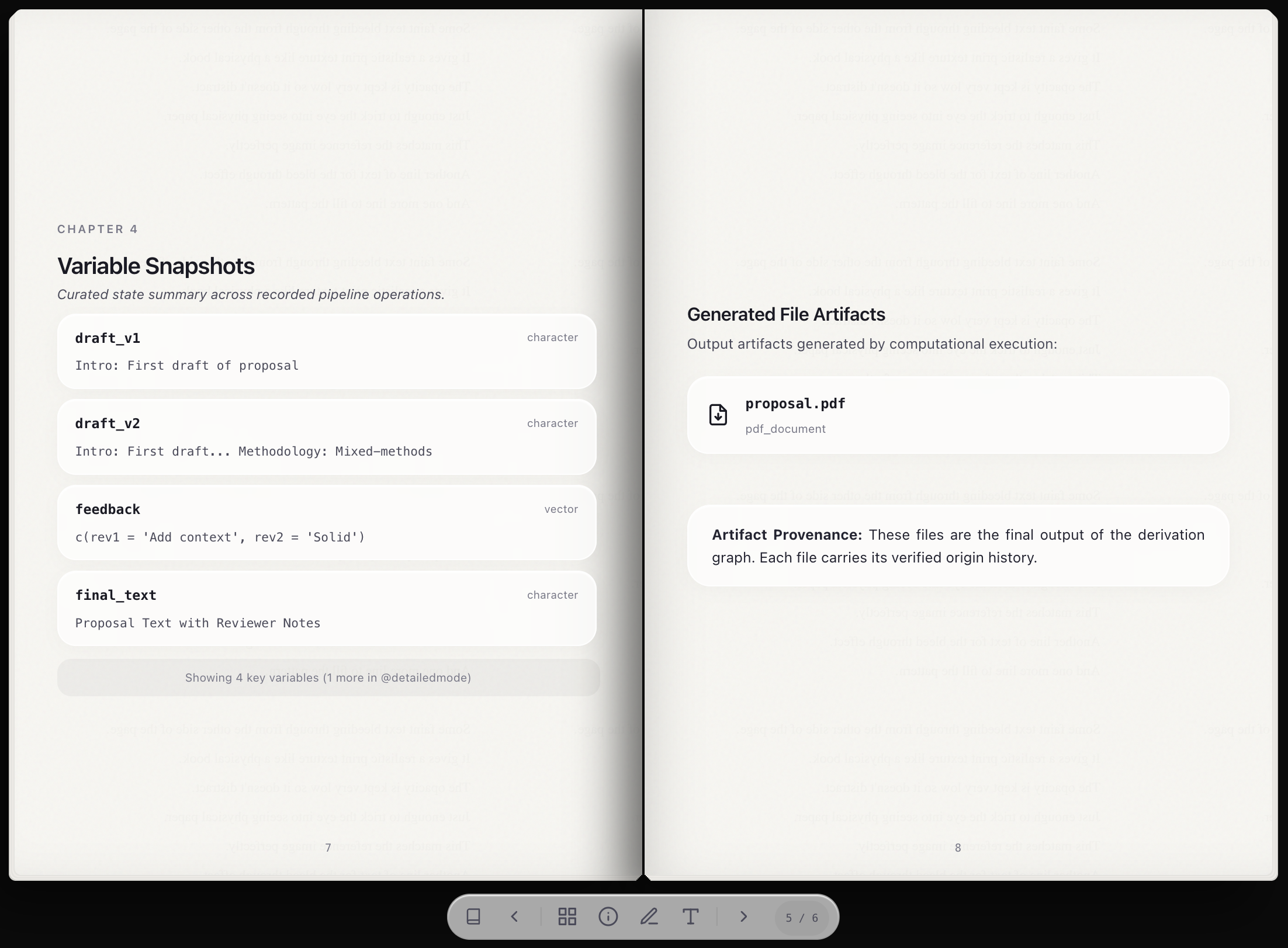
Features
- Interactive Lineage Graph: Directed acyclic graph (DAG) visualization of data derivation, tracking operations (functions) and entities (variables, dataframes, files).
- Cryptographic File Hash Integrity: MD5 hash validation of generated file artifacts to guarantee authenticity and reproducibility across environments.
- W3C PROV-JSON Standard Compliance: Full compatibility with the W3C PROV-JSON standard and End-to-End Extended Provenance specification.
- Sub-second Execution Timeline: Granular operation duration and temporal ordering tracking for R workflows.
- Standalone Static Export: Zero-backend deployment — compiles to plain HTML/CSS/JS ready for GitHub Pages, Netlify, or local offline reading.
Ecosystem
provBookR is part of the End-to-End Provenance (E2E) ecosystem. It seamlessly integrates with the suite’s specialized tools:
rdtLite: Traces script execution and captures fine-grained provenance graphs.provSummarizeR/provExplainR: Complements textual summaries and run-to-run diffing by providing an interactive visual reading experience.provDebugR: Complements terminal-based time-travel debugging with high-level visual lineage navigation.
Installation
Install from GitHub:
# install.packages("devtools")
devtools::install_github("End-to-end-provenance/provBookR")
Once installed, load the package:
library(provBookR)
Usage
1. Publishing an Interactive Web Codex
The primary method for generating a provenance booklet is through the publish_codex function. This automates the process of tracing the script, compiling the frontend interface, and exporting a static HTML directory.
# Automatically trace myscript.R and build a static web booklet
provBookR::publish_codex("myscript.R", output_dir = "my_provbook")
This generates a my_provbook/ folder containing the static HTML, CSS, and JS files. The index.html file can be opened directly in a browser or hosted via standard static site hosting services (e.g., GitHub Pages).
2. Local Booklet Preview (preview_codex)
To view the compiled booklet locally without running into browser Same-Origin (CORS) restrictions on local file:// URLs, use preview_codex:
# Launch a local server to preview your built codex
provBookR::preview_codex(output_dir = "my_provbook", port = 8000)
Note on Legacy Prototypes: Early 2019 terminal-based interactive CLI prototypes (
provBookR(..., mode="full")) are archived ininst/legacy/for historical reference.
Ecosystem & Citation
provBookR is developed within the End-to-End Provenance Project, a multi-institutional research initiative supported by Mount Holyoke College, Harvard University, the University of British Columbia, and the National Science Foundation (NSF).
If you use provBookR in your research, please cite the End-to-End Provenance project:
Lerner, B., Boose, E., & Perez, F. Using End-to-End Provenance to Support Reproducibility in R. The End-to-End Provenance Project. https://github.com/End-to-end-provenance